What is said in your church, in the language of whoever is listening.
And not just the Mass: August's pilgrims, May's wedding, the guided tour, the gathering of priests and what stays written down afterwards. We install it ourselves, on the sound system you already have.
How it works
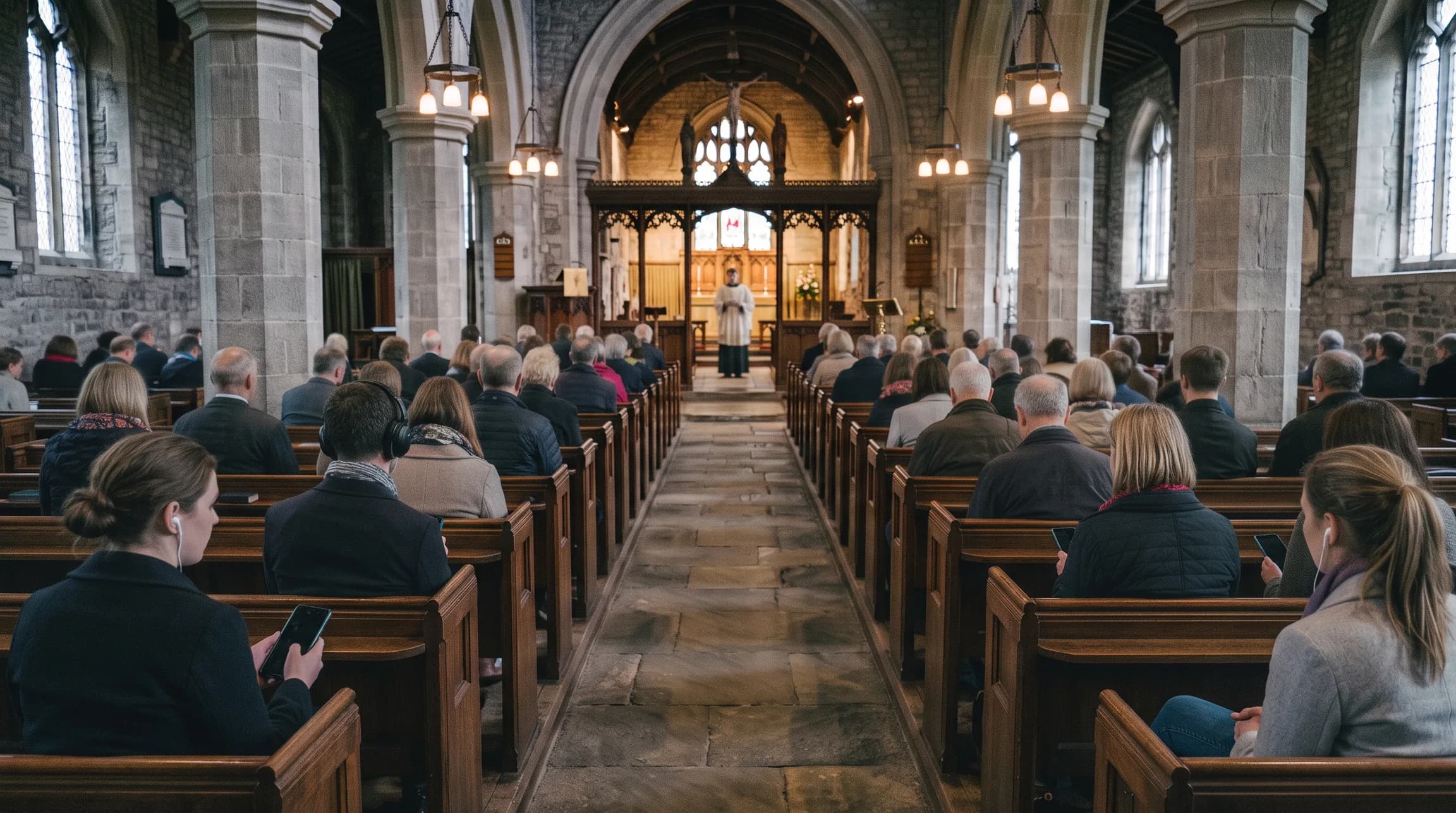
Equipment in the room, the audio going out to the engine and the translation arriving on the phone of whoever is listening. More than five hours straight, in one of the most hostile acoustic environments there is.
A full nave, each in their own language.
The priest speaks from the lectern the way he always speaks. What he says once reaches every pew, and each person hears it in their own: no booth, no receivers and nobody handing anything out at the door.
Stone forgives nothing, and everything depends on it.
A stone nave sends a voice back three and four times. It is the hardest place we have ever got this working, and it is where the figures we quote on the rest of this site come from.
The vault is the same on both sides
We don't remove it, and we can't: it is still up there. What gets decided on installation day is whether the voice reaches the microphone before the vault touches it.
The microphone outranks everything else
The lectern mic and the clip-on mic pick up a clean voice. A microphone hung in the nave picks up the whole nave — and what an ear can't make out, a machine can't either.
The test takes two minutes
Before you sign anything: record two minutes on a phone held against one of the PA speakers, and listen back. If you can understand it, so can we.
This was never about the Mass: it is about the whole year.
Mass is one hour a week. What a parish, a cathedral or a shrine actually has ahead of it is a full year of moments where somebody speaks and somebody doesn't understand.
Mass, every Sunday
The priest speaks the way he always speaks. Anyone who doesn't understand the language opens a link on their phone, picks their own and hears it a few seconds later.
The summer pilgrims
In a place people pass through, you don't know whether Sunday brings Germans or Koreans. Both can be open at once, and a group arriving with its own guide can have its own room.
Weddings and funerals across two countries
Half the chapel from one family and half from the other. It's a single day: switched on that morning and off when it ends.
The guided tour
A church that is also visited, and a museum next door. The group scans a code at the start and each person follows the guide in their own language.
Catechesis, courses and training
Classes and courses where language can't be the entry filter — above all with families who have just arrived.
Gatherings and conferences
A gathering of priests, a diocesan day, or a general chapter with delegations from many countries.
The council, and what was agreed
A pastoral or finance council leaves its minutes: what was decided, who takes what away and at which minute it was said.
What gets printed and sent out
The parish newsletter, a pastoral letter, a decree. Whole documents translated, with nothing to lay out again.
For whoever is listening: a code and that's it
Nothing has to be handed out. No receivers, no headsets to give back, no batteries, nobody at the door counting them. The code goes on the parish newsletter, on the sign at the entrance or stuck to the pew: point the camera, pick a language, listen.
One code and that’s it
No app, no account.
point at the code
pick your language
listen and read
And anyone who comes back — a neighbourhood parish, a shrine people walk to every year — installs the app with your name on it from that same code, and next time gets in without looking for anything.
And when it is one to one
Almost everything we show is one person speaking and many listening. But in a shrine the opposite happens constantly: someone arrives from abroad, doesn't speak the language, and wants to talk to a person for ten minutes, both ways.
It runs in both directions
Each person speaks in their own and hears the other in theirs. Nobody has to settle on a common language or pass a device back and forth.
There is no button to press
You speak and you get an answer. Nobody has to wait for the other one to finish listening before they can start.
And nothing is left behind
The voice is never stored. When the conversation ends there is no list, no history and no file.
If the Mass is already streamed
Plenty of parishes already broadcast. Two different things fit in there and it pays not to confuse them: translating, for people who don't speak the language, or subtitling, for people who do and can't hear well. You can have both: it translates when there is somebody to translate for and subtitles when there is not, sentence by sentence.
Translate
COMES WITH THE TEXT
Text
TURNS ITSELF ON
Voice and text, and the minutes when you are done.
No text, no minutes: the room isn’t created.
And for the video that stays online afterwards, the subtitles come out with their timings, ready to lay over it.
See how the subtitles come outAnd if you want it, it stays written down.
The text doesn't switch itself on, and it isn't ours: it's yours. A parish can want none of this and use only the live translation — the voice is never stored, with the text on or off.
Nothing is left unless you ask for it
The live side works without leaving a trace. The text only exists if the room is set to keep it, and that is your decision, not the celebration's.
And whatever is kept is yours
The parish newsletter, the website, or whoever couldn't come. It comes out in every language that was open, with nothing to type again.
Including what you already had recorded
Older recordings turn into text and get translated. They didn't have to be said with this installed.
And when the clergy meet each other
A gathering of priests, a diocesan day, a general chapter with sisters from thirty countries. That is a multilingual conference, and it gets set up as one: one room per physical room, with its languages and its link.
Gatherings and diocesan days
Each room with its own languages. Adding one the day before is a change in the panel, not a hire.
General chapters
Weeks of sessions and delegations from many countries. No booths, no platform, and nothing to hand out every morning.
And the minutes at the end
Each session leaves its transcript with the timings, and out of that comes what was decided and who takes what away.
And if it can't leave the building
The audio is transcribed and translated inside the building and does not leave it. The whole engine can run on your own hardware: there is no third-party API to trust, because there is none to call.
Who does what
Us
- Coming out, looking at the nave and talking to whoever runs the sound.
- Taking an aux out of your mixer and leaving the equipment hooked up.
- Setting up the rooms, the languages and the codes that get printed.
- Testing it in the nave, with your sound, before anyone arrives.
- Keeping it running and being on hand when it matters.
You
- Telling us what is celebrated and which languages are needed.
- Speaking the way you always speak.
When this is not for you
Four things we would rather tell you ourselves than have you find out.
If there is no mixing desk
The audio comes off an aux out of the desk you already have. With no desk, or with a microphone picking up the whole nave, the result drops a long way.
Latin is not there
The engine translates into fifteen languages and none of them is Latin. The sung Latin Ordinary is not going to come out. The homily, the readings and the introductions — which is what people need to understand — will.
An interpreter understands intent
A machine translates what was said. For a prepared homily the difference is small; for a difficult conversation it is not.
And headphones are needed
A phone playing out loud in a nave disturbs the people next to it. Anyone without their own can still read it perfectly well.
This has no price list: it has a quote
No two churches are alike. It depends on the hours, the languages, whether the equipment stays put or goes up for a day, and whether we have to travel. What there is, is a closed figure before we start and no surprises afterwards.
Would you rather set it up yourselves and pay by the minute? That is the integrations, and they have public pricing.
See integration pricingTell us about your event
Four details and we will tell you whether we can do it and what it costs. We answer within 48 hours.
Tell us what you celebrate and we'll tell you how it's done
A parish with summer tourists, a Mass broadcast every morning, or a single day's gathering. Four details and we know almost everything.
Tell us about your case