Notes from a meeting
When the meeting ends we give you back what was decided, who takes each task, and the minute it was said. It joins the queue when the room closes, it reaches you by email, and you can download it here for fifteen days.
- Fifteen languages
- You pay for speech, not silence
- No monthly fee
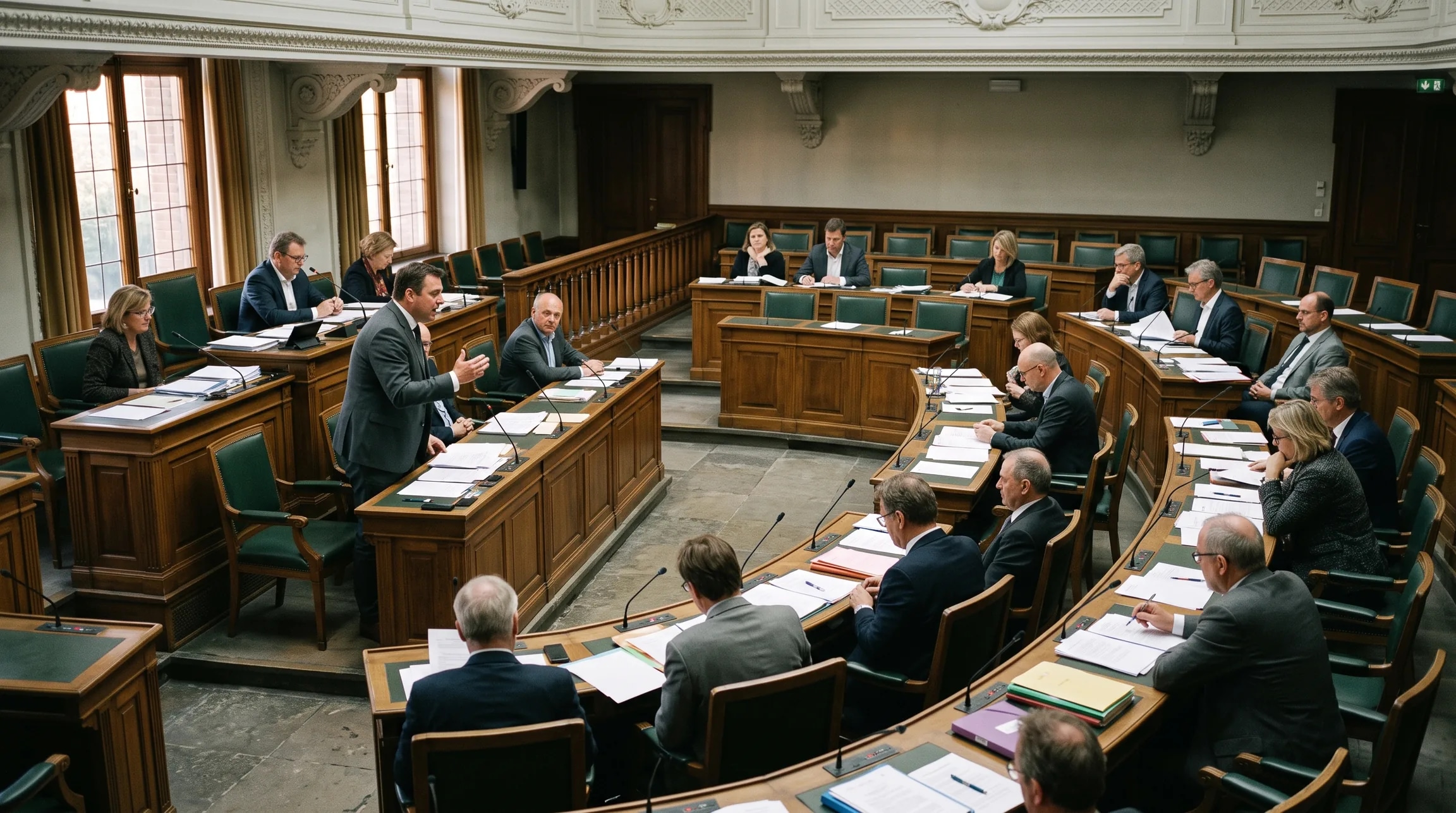
Who it is for
Anyone who has to put on paper what happened in a room. A council session that by law has to exist afterwards. A committee that decides something and argues a week later about what was agreed. And above all a meeting in three languages, where half the room followed half of it.
From the room to your inbox
Three moments, and none of them asks anything of you.
1 · In the room
2 · When it ends
3 · When it is ready
1 · In the room
El coste sube un ocho por ciento.
Und wer trägt die Differenz?
On a le rapport technique ?
Everyone speaks their own
The engine is already writing down what is said, in the language it is said in.
2 · When it ends
Notes — Council session
12 March · 1 h 47 min · 63 min of speech
- Queued
- In progress
- Ready
The job joins the queue
How long it takes depends on how long the meeting was and how busy the servers are.
3 · When it is ready
To: clerk@council.example
Notes — Council session, 12 March
It reaches you, and you download it
Fifteen days to download it from here. The emailed copy stays with you.
Translating is optional
A room can translate, subtitle, or do both. What never happens is the same sentence being translated and subtitled: it is translated when there is somebody to translate for, and subtitled when there is not.
Subtitling without translating costs 1.25 credits per spoken minute and does not multiply per language, because what you see is what is said. And it is decided sentence by sentence: turn translation on halfway through and what came before still counts as subtitles.
Subtitles are always seen in the meeting, kept or not. Keeping is a different thing and the account decides it, not the meeting: what is said is kept for fifteen days and then destroyed.
Translate
COMES WITH THE TEXT
Text
TURNS ITSELF ON
Voice and text, and the minutes when you are done.
No text, no minutes: the room isn’t created.
Translating already brings the text
You cannot translate without first recognising what is said, so a room that translates is already producing the text. It is not a separate product: it comes with the translation.
And you can subtitle without translating
That is the council meeting held entirely in one language: there is nobody to translate for, and the text is needed all the same. And also the room that translates and where, today, everybody speaks the same — with both switched on it subtitles while they share a language, and moves to translating on its own the moment somebody else walks in.
What you cannot do is keep it with neither
No text, no minutes, and it is refused rather than leaving you a room that says it keeps and keeps nothing.
Where it can come from
Three routes, and the same document at the end.
A room already being translated
A meeting in the app, in Teams, or in a live room. Here we know who is speaking because each person has their own place: attribution is not guessed.
You upload a recording
Whatever you have, in the usual formats. It is transcribed, the voices are separated, and the notes come out. This is the route for whoever has the session recorded but not the room.
You upload a text
If you already have what was said in writing, no audio is needed: it is punctuated, ordered and summarised. What the text does not carry — who spoke, at which minute — the notes cannot invent.
How it works
- 1
The meeting happens as usual: in the room, in Microsoft Teams, or by uploading a recording you already have.
- 2
When it ends, the job joins the queue. It is not done live: it is done once the meeting is over.
- 3
The text is punctuated, every line gets its voice and its minute, and it is summarised: decisions and tasks.
- 4
It reaches the address you choose by email, and you can also download it here for fifteen days.
What you get
- The summary: what was decided and what is still open, each with the minute it was said.
- And the whole document of who said what, punctuated, start to finish.
- In whichever of the fifteen languages you ask for, whatever was spoken in the room.
- As plain text, as Markdown and as PDF, by email and to download for fifteen days.
- Marked as a draft, and we mean it: on a clean recording, telling voices apart can approach 85 % — the best case, not the norm — and whoever signs off on minutes has to read them.
- And the audio is never stored. Never. All of this runs on the text.
Where the limit is: Up to four hours of audio, one hour of video, and 800 MB per recording, and three jobs queued at a time. The notes are kept for fifteen days from the moment they are ready: within that window you download them here, and by email you keep them for good, because that copy is yours.
This is what you get
An example with made-up data, so you can see the shape. The real notes come out with what was said in your meeting.
Council session
12 March · 1 h 47 min · 63 min of speech
Decisions
The budget for the square refurbishment is approved, with the 8 % increase over the original plan.
14:02The terraces bylaw is deferred to the next session, pending the technical report.
41:18Tasks
Planning — Request the technical report on terraces before Friday.
43:07Clerk's office — Publish the notes on the transparency portal.
58:22Full record, if you ask for it
Planning councillor — «The cost is up eight per cent on the original plan, and most of it is the road surface.»
Group spokesperson — «Is there a plan for diverting traffic while the works last?»
It comes out marked as a draft: on a clean recording, telling voices apart can approach 85 % — the best case — and whoever signs off has to read it.
What it costs
1 credit per spoken minute, per language
Speech is charged, not duration: in a one-hour meeting where twenty minutes were spoken, you pay for twenty. The full notes cost 1 credit per spoken minute and per language — either there are notes or there are not, there is no cheaper half. And it comes out of the same pot of credits as everything else, not a separate bill.
See pricingQuestions
- How long does it take?
- It depends on how long the meeting was and how busy the servers are at that moment: it can be faster or slower. That is why we tell you when it is ready instead of promising an hour we could not always keep.
- Can I have it while the meeting is happening?
- No, and that is deliberate. The notes are made afterwards, in the background. Doing it live would put them in competition for the same card that is translating the room, which is exactly what we do not want.
- How long do you keep it?
- Fifteen days, the same as everything else we keep. That is also why it is emailed to the address you choose: that is the copy that stays with you when ours is deleted.
- Is what was said stored?
- Only if it is turned on, and the account decides that, not the meeting: keeping what people say is the decision of whoever pays. By default it is discarded when the session closes. When it is on the room says so, it is fifteen days, and after that it is destroyed.
- Does it count as official minutes?
- No. It comes out marked as a draft and has to be read before it is signed. On a clean recording, telling voices apart can approach 85 %; with noise or strong accents, less. It is a good starting point, not a certainty. And the summary catches the main things, not everything: over a long meeting it picks up most of what was decided, not every item. That is why it comes as a draft.
- What if the meeting was in several languages?
- That is the case it was built for. Each voice is transcribed in the language it spoke, and the notes come out in the one you ask for.
- Can I run it on my own servers?
- The record yes, on any installation. The summary needs a card with at least 24 GB, so there you have to look at the hardware before promising anything.
The rest of what happens to a file
The same file, the same engine and the same pot of credits. Almost nobody needs just one of these: whoever transcribes a session ends up wanting to know who spoke.
The words only used in your house
An organisation's own names — people, streets, references, job titles — are exactly what a general model has never heard, and where it fails: it swaps them for an ordinary word that sounds similar. Write them once and they stop failing. You write them in the job and they hold for that recording.
- It is a list, not training: you write it and it works from the first sentence.
- It collects nothing. Not your audio, not your text, not one second of anything.
- And it is included. Not an extra plan, not a line on the bill.
Start with the meeting nobody wants to write up
The long one, the one in three languages, the one that ends with four people arguing about what was agreed. That is the one that tells you whether this is any use to you.
Get started